<?xml version="1.0" encoding="utf-8"?><feed xmlns="http://www.w3.org/2005/Atom" ><generator uri="https://jekyllrb.com/" version="4.0.1">Jekyll</generator><link href="https://animathad.github.io/feed.xml" rel="self" type="application/atom+xml" /><link href="https://animathad.github.io/" rel="alternate" type="text/html" /><updated>2026-09-06T23:40:34-07:00</updated><id>https://animathad.github.io/feed.xml</id><subtitle>Anirudh Mathad — engineering manager in Adobe&apos;s Builders Experience group. Essays and working notes on AI, developer platforms, and the systems that scale them.</subtitle><author><name>Anirudh Mathad</name></author><entry><title type="html">The quiet charm of San Francisco</title><link href="https://animathad.github.io/post/san-francisco-fonts" rel="alternate" type="text/html" title="The quiet charm of San Francisco" /><published>2026-09-06T00:00:00-07:00</published><updated>2026-09-06T00:00:00-07:00</updated><id>https://animathad.github.io/post/san-francisco-fonts</id><content type="html" xml:base="https://animathad.github.io/post/san-francisco-fonts"><![CDATA[<p>I keep coming back to Apple’s <a href="https://developer.apple.com/fonts/">San Francisco fonts</a>.</p>

<p>They are somehow both simple and perfectly cute.</p>

<p>That combination is harder to achieve than it looks. Minimalism can easily become cold. A typeface can be clean but feel sterile, polished but forgettable. San Francisco does something gentler. Its letters are quiet and precise, but they still have warmth. The rounded shapes soften the interface. The spacing lets everything breathe. Even a plain settings screen can feel considered.</p>

<p>Maybe that is what I crave when I look at it: not the font itself, but the sense of calm it creates.</p>

<p>San Francisco does not compete with the words. It makes them easier to find, scan, and understand. Small text remains clear. Large text feels confident without becoming loud. The typeface seems to know when to step forward and when to disappear into the interface.</p>

<p>That is probably why it feels so unmistakably Apple. It carries the same idea as the hardware: remove the obvious decoration, obsess over the details, and leave behind something that feels inevitable.</p>

<p>Of course, no font can make a cluttered design minimal. It cannot fix a confusing hierarchy or too many ideas fighting for attention. But a good typeface can set the mood. San Francisco quietly asks the rest of the design to be disciplined.</p>

<p>I have spent too many hours changing themes and fonts instead of writing. Still, I understand the temptation. Sometimes a font makes you want to create the kind of world it belongs in.</p>

<p>San Francisco makes me want to make things that are clear, minimal, and just a little bit cute.</p>]]></content><author><name>Anirudh Mathad</name></author><category term="design" /><category term="typography" /><category term="apple" /><summary type="html"><![CDATA[A small appreciation of Apple's San Francisco typeface and the calm, clarity, and character it brings to a screen.]]></summary></entry><entry><title type="html">Why I&apos;m writing here</title><link href="https://animathad.github.io/post/why-im-writing-here" rel="alternate" type="text/html" title="Why I&apos;m writing here" /><published>2026-07-30T00:00:00-07:00</published><updated>2026-07-30T00:00:00-07:00</updated><id>https://animathad.github.io/post/why-im-writing-here</id><content type="html" xml:base="https://animathad.github.io/post/why-im-writing-here"><![CDATA[<p>I've decided to keep a proper home on the internet again — a place that isn't a social feed, isn't owned by a platform optimizing for outrage, and isn't going anywhere when the next app dies.</p>

<p>The plan is simple. Two kinds of writing live here:</p>

<ul>
  <li><strong>The <a href="/posts">blog</a></strong> — finished thoughts. Essays I've sat with long enough to stand behind. These are dated and mostly done.</li>
  <li><strong>The <a href="/notes">garden</a></strong> — everything still growing. Working notes, half-formed ideas, things I'm actively researching. They're interlinked, they change over time, and they're honest about being unfinished. Start with [[Start Here]] if you're curious.</li>
</ul>

<p>What will I write <em>about</em>? Mostly the things I spend my days on: <strong>AI</strong>, <strong>developer platforms</strong>, and the unglamorous systems that let large engineering organizations actually move. I lead a team at Adobe building what we're calling AI factories — so expect a lot of thinking-out-loud about what that even means (I've started that in [[AI factories]]).</p>

<p>Some of it will be technical. Some will be about the craft of engineering leadership. Some will just be me trying to understand something by writing it down, which is the only way I've ever really understood anything.</p>

<p>No newsletter, no growth funnel, no pop-ups. Just writing. If something here is useful to you, that's a happy accident — this is mostly me thinking in public.</p>

<p>Thanks for reading. More soon.</p>]]></content><author><name>Anirudh Mathad</name></author><category term="meta" /><category term="writing" /><summary type="html"><![CDATA[A short note on why I'm keeping a personal site — and what I plan to put on it.]]></summary></entry><entry><title type="html">GANs vs Transformers: Two Paradigms in Deep Learning</title><link href="https://animathad.github.io/post/gans-vs-transformers-two-paradigms-in-deep-learning" rel="alternate" type="text/html" title="GANs vs Transformers: Two Paradigms in Deep Learning" /><published>2025-01-13T00:00:00-08:00</published><updated>2025-01-13T00:00:00-08:00</updated><id>https://animathad.github.io/post/gans-vs-transformers-two-paradigms-in-deep-learning</id><content type="html" xml:base="https://animathad.github.io/post/gans-vs-transformers-two-paradigms-in-deep-learning"><![CDATA[<p><img src="/assets/img/posts/gans-vs-transformers-two-paradigms-in-deep-learning/image-2.png" alt="" /></p>

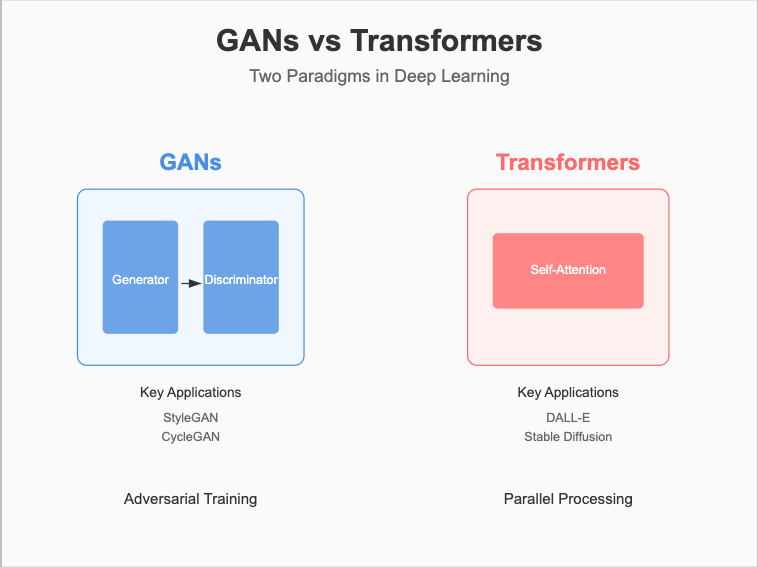
<h2 id="core-architectures">Core Architectures</h2>

<h3 id="gans-generative-adversarial-networks">GANs (Generative Adversarial Networks)</h3>

<p><strong>Key Innovation</strong>: <em>Two-network adversarial training</em></p>

<ul>
  <li><strong>Generator</strong>: Creates synthetic data</li>
  <li><strong>Discriminator</strong>: Identifies real vs fake data</li>
  <li><strong>Training Process</strong>: Zero-sum game where networks compete to improve</li>
</ul>

<h3 id="transformers">Transformers</h3>

<p><strong>Key Innovation</strong>: <em>Self-attention mechanism</em></p>

<ul>
  <li><strong>Architecture</strong>: Multi-headed attention layers</li>
  <li><strong>Processing</strong>: Parallel computation of sequence elements</li>
  <li><strong>Distinctive Feature</strong>: Direct modeling of long-range dependencies</li>
</ul>

<h2 id="primary-applications">Primary Applications</h2>

<h3 id="gan-strengths">GAN Strengths</h3>

<ul>
  <li><strong>Image Synthesis</strong>: Photorealistic image generation</li>
  <li><strong>Style Transfer</strong>: Converting artistic styles between images</li>
  <li><strong>Data Augmentation</strong>: Creating synthetic training data</li>
</ul>

<h3 id="transformer-strengths">Transformer Strengths</h3>

<ul>
  <li><strong>Natural Language Processing</strong>: Text understanding and generation</li>
  <li><strong>Multi-modal Tasks</strong>: Text-to-image generation</li>
  <li><strong>Sequential Data</strong>: Time series and music generation</li>
</ul>

<h2 id="recent-developments">Recent Developments</h2>

<p><strong>Transformer Advances</strong>:</p>

<ul>
  <li><em>DALL-E</em>: Revolutionary text-to-image generation</li>
  <li><em>Stable Diffusion</em>: Efficient image synthesis</li>
  <li><em>GPT series</em>: Advanced language modeling</li>
</ul>

<p><strong>GAN Innovations</strong>:</p>

<ul>
  <li><em>StyleGAN</em>: High-quality face generation</li>
  <li><em>CycleGAN</em>: Unpaired image translation</li>
  <li><em>Progressive GANs</em>: High-resolution synthesis</li>
</ul>

<h2 id="practical-considerations">Practical Considerations</h2>

<p><strong>When to Use GANs</strong>:</p>

<ul>
  <li>Need for highly realistic synthetic data</li>
  <li>Focus on visual quality</li>
  <li>Domain-specific data generation</li>
</ul>

<p><strong>When to Use Transformers</strong>:</p>

<ul>
  <li>Complex sequential processing</li>
  <li>Need for interpretable attention patterns</li>
  <li>Multi-modal applications</li>
</ul>

<h2 id="future-outlook">Future Outlook</h2>

<p>The field is witnessing a convergence, with Transformer-based architectures increasingly entering traditional GAN domains. However, both architectures continue to evolve and find specialized applications where their unique strengths shine.</p>]]></content><author><name>Anirudh Mathad</name></author><summary type="html"><![CDATA[Core Architectures GANs (Generative Adversarial Networks) Key Innovation: Two-network adversarial training Transformers Key Innovation: Self-attention…]]></summary></entry><entry><title type="html">The Perfect Vibe: Music for Focused Software Engineering</title><link href="https://animathad.github.io/post/the-perfect-vibe-music-for-focused-software-engineering" rel="alternate" type="text/html" title="The Perfect Vibe: Music for Focused Software Engineering" /><published>2025-01-11T00:00:00-08:00</published><updated>2025-01-11T00:00:00-08:00</updated><id>https://animathad.github.io/post/the-perfect-vibe-music-for-focused-software-engineering</id><content type="html" xml:base="https://animathad.github.io/post/the-perfect-vibe-music-for-focused-software-engineering"><![CDATA[<p>Software engineering often requires intense concentration, whether debugging code, designing system architectures, or writing documentation. Many engineers turn to music to create the perfect focus-friendly environment. But what makes music effective for focus, and how do you find the right vibe for your workflow?</p>

<p><img src="/assets/img/posts/the-perfect-vibe-music-for-focused-software-engineering/image-1.png" alt="" /></p>

<h4 id="why-music-helps-with-focus">Why Music Helps with Focus</h4>

<p>The right kind of music can create a cocoon that shields your brain from distractions. It taps into a phenomenon called “white noise masking,” where background sounds help drown out disruptive noises in your environment. Moreover, music can enhance mood, maintain energy levels, and stimulate a flow state—a psychological zone of maximum productivity.</p>

<h4 id="types-of-music-vibes-that-work">Types of Music Vibes That Work</h4>

<p>The effectiveness of music for focus depends on personal preferences, but certain genres and styles resonate particularly well with software engineers:</p>

<ol>
  <li><strong>Ambient and Atmospheric Tracks</strong>
    <ul>
      <li>Genres: Ambient, chillout, downtempo</li>
      <li>Why it works: These tracks often lack lyrics and feature soothing, repetitive patterns that create a calm mental space without pulling your attention away.</li>
      <li>Recommended Artists: Brian Eno, Tycho, Aphex Twin (ambient works)</li>
    </ul>
  </li>
  <li><strong>Instrumental Beats</strong>
    <ul>
      <li>Genres: Lo-fi hip-hop, jazz, classical</li>
      <li>Why it works: These genres offer rhythm and movement without the distraction of lyrics. Lo-fi hip-hop, with its soft beats and crackling vinyl undertones, is especially popular among developers.</li>
      <li>Recommended Channels: Lofi Girl, Chillhop Music</li>
    </ul>
  </li>
  <li><strong>Electronic and Synthwave</strong>
    <ul>
      <li>Genres: Minimal techno, synthwave, house</li>
      <li>Why it works: The driving beats and futuristic soundscapes in these genres can match the methodical, logic-driven nature of coding.</li>
      <li>Recommended Artists: Bonobo, Kavinsky, Boards of Canada</li>
    </ul>
  </li>
  <li><strong>Classical and Cinematic Scores</strong>
    <ul>
      <li>Genres: Baroque classical, film scores, video game soundtracks</li>
      <li>Why it works: Orchestral music, particularly without vocals, evokes emotion and grandeur, often inspiring deep thought and creativity.</li>
      <li>Recommended Works: Hans Zimmer’s soundtracks, Ludovico Einaudi, and video game scores like the “Celeste” or “Ori and the Blind Forest” soundtracks.</li>
    </ul>
  </li>
  <li><strong>Nature Sounds and White Noise</strong>
    <ul>
      <li>Why it works: Sometimes, non-musical sounds like rain, waves, or forest ambiance provide the ideal backdrop, especially for those who find melodies distracting.</li>
      <li>Recommended Platforms: Noisli, myNoise</li>
    </ul>
  </li>
</ol>

<h4 id="choosing-the-right-vibe-for-your-task">Choosing the Right Vibe for Your Task</h4>

<p>Different tasks may call for different vibes:</p>

<ul>
  <li><strong>Deep Focus (e.g., debugging or learning a new framework):</strong> Try minimalist ambient or classical music.</li>
  <li><strong>Creative Work (e.g., designing an architecture diagram):</strong> Opt for cinematic scores or synthwave.</li>
  <li><strong>Repetitive Tasks (e.g., writing boilerplate code):</strong> Lo-fi hip-hop or electronic beats can help maintain momentum.</li>
</ul>

<h4 id="tips-for-creating-your-focus-playlist">Tips for Creating Your Focus Playlist</h4>

<ol>
  <li><strong>Avoid Lyrics:</strong> Words in songs can compete with your thought process.</li>
  <li><strong>Pick Tracks with Steady Tempos:</strong> Predictable rhythms minimize mental interruptions.</li>
  <li><strong>Experiment with Playlists:</strong> Services like Spotify, YouTube, or SoundCloud offer curated playlists tailored for focus.</li>
  <li><strong>Adapt to Your Environment:</strong> If your workspace is noisy, consider noise-canceling headphones or tracks with white noise elements.</li>
</ol>

<h4 id="final-thoughts">Final Thoughts</h4>

<p>The right music doesn’t just help you focus—it transforms the coding experience into an immersive journey. Experiment with different vibes to discover what resonates best with your unique workflow. Whether it’s lo-fi beats or orchestral crescendos, there’s a soundtrack out there to amplify your productivity and creativity.</p>]]></content><author><name>Anirudh Mathad</name></author><category term="music" /><category term="new-music" /><category term="news" /><category term="playlist" /><category term="productivity" /><summary type="html"><![CDATA[Software engineering often requires intense concentration, whether debugging code, designing system architectures, or writing documentation. Many…]]></summary></entry><entry><title type="html">Converting YOLOv11.pt to YOLOv11.onnx: A Step-by-Step Guide</title><link href="https://animathad.github.io/post/converting-yolov11-pt-to-yolov11-onnx-a-step-by-step-guide" rel="alternate" type="text/html" title="Converting YOLOv11.pt to YOLOv11.onnx: A Step-by-Step Guide" /><published>2024-12-30T00:00:00-08:00</published><updated>2024-12-30T00:00:00-08:00</updated><id>https://animathad.github.io/post/converting-yolov11-pt-to-yolov11-onnx-a-step-by-step-guide</id><content type="html" xml:base="https://animathad.github.io/post/converting-yolov11-pt-to-yolov11-onnx-a-step-by-step-guide"><![CDATA[<h2 id="introduction">Introduction</h2>

<p>YOLO (You Only Look Once) is a popular real-time object detection algorithm known for its speed and accuracy.  Different versions of YOLO, like YOLOv11, often come with pre-trained weights in the .pt (PyTorch) format. However, for deployment on various platforms or frameworks, you might need to convert these weights to the .onnx (Open Neural Network Exchange) format.</p>

<p>This blog post will guide you through the process of converting a YOLOv11 model from .pt to .onnx format, enabling broader compatibility and deployment options.</p>

<h2 id="why-convert-to-onnx">Why Convert to ONNX?</h2>

<ul>
  <li><strong>Framework Interoperability:</strong> ONNX provides a common format for machine learning models, allowing you to use your YOLOv11 model in frameworks like TensorFlow, Caffe2, and more.</li>
  <li><strong>Hardware Acceleration:</strong> Many hardware accelerators and inference engines have optimized support for ONNX models, potentially leading to faster inference times.</li>
  <li><strong>Model Optimization:</strong>  Tools and techniques exist to optimize ONNX models for size and performance.</li>
</ul>

<h2 id="prerequisites">Prerequisites</h2>

<p>Before you begin, ensure you have the following:</p>

<ul>
  <li><strong>PyTorch:</strong>  The deep learning framework used to train and export the YOLOv11 model.</li>
  <li><strong>ONNX:</strong> The ONNX library for working with ONNX models.</li>
  <li><strong>YOLOv11 Model:</strong> The YOLOv11 model with pre-trained weights in .pt format.</li>
</ul>

<h2 id="step-by-step-conversion">Step-by-Step Conversion</h2>

<ol>
  <li><strong>Install Dependencies:</strong>pip install onnx onnxruntime</li>
  <li><strong>Load Your YOLOv11 Model:</strong>import torch</li>
</ol>

<p>model = torch.load(‘yolov11.pt’)</p>

<p>model.eval()  # Set the model to evaluation mode</p>

<ol>
  <li><strong>Create Sample Input:</strong>dummy_input = torch.randn(1, 3, 640, 640)  # Example input shape</li>
  <li><strong>Export to ONNX:</strong>torch.onnx.export(model, dummy_input, “yolov11.onnx”,</li>
</ol>

<p>                  opset_version=11,  # Choose an appropriate opset version</p>

<p>                  input_names=[‘input’], output_names=[‘output’])</p>

<ol>
  <li><strong>Verify the ONNX Model:</strong>import onnx</li>
</ol>

<p>onnx_model = onnx.load(“yolov11.onnx”)</p>

<p>onnx.checker.check_model(onnx_model)</p>

<h2 id="troubleshooting">Troubleshooting</h2>

<ul>
  <li><strong>Opset Version:</strong> If you encounter errors during export, try changing the <code class="highlighter-rouge">opset_version</code> to a different value.</li>
  <li><strong>Model Architecture:</strong> Some custom model architectures might not be fully supported by ONNX. Refer to the ONNX documentation for compatibility.</li>
</ul>

<h2 id="conclusion">Conclusion</h2>

<p>Converting your YOLOv11 model from .pt to .onnx opens up a world of possibilities for deployment and optimization. With the .onnx format, you can seamlessly integrate your model into various frameworks and leverage hardware acceleration for faster inference.</p>]]></content><author><name>Anirudh Mathad</name></author><category term="ai" /><category term="artificial-intelligence" /><category term="llm" /><category term="machine-learning" /><category term="technology" /><summary type="html"><![CDATA[Introduction YOLO (You Only Look Once) is a popular real-time object detection algorithm known for its speed and accuracy.  Different versions of YOLO,…]]></summary></entry><entry><title type="html">Exploring the ONNX Format: A Deep Dive into Open and Interoperable AI Models</title><link href="https://animathad.github.io/post/exploring-the-onnx-format-a-deep-dive-into-open-and-interoperable-ai-models" rel="alternate" type="text/html" title="Exploring the ONNX Format: A Deep Dive into Open and Interoperable AI Models" /><published>2024-12-30T00:00:00-08:00</published><updated>2024-12-30T00:00:00-08:00</updated><id>https://animathad.github.io/post/exploring-the-onnx-format-a-deep-dive-into-open-and-interoperable-ai-models</id><content type="html" xml:base="https://animathad.github.io/post/exploring-the-onnx-format-a-deep-dive-into-open-and-interoperable-ai-models"><![CDATA[<h2 id="introduction">Introduction</h2>

<p>In the rapidly evolving landscape of artificial intelligence (AI) and machine learning (ML), the ability to seamlessly transfer and deploy models across different frameworks and hardware has become paramount. Enter the Open Neural Network Exchange (ONNX) format, a game-changer that fosters interoperability and collaboration in the AI community.</p>

<h2 id="what-is-onnx">What is ONNX?</h2>

<p>ONNX is an open standard for representing machine learning models. It defines a common set of operators and a file format that enables AI models to be transferred between different frameworks, tools, and platforms. This interoperability eliminates the need for developers to be locked into a single framework, allowing them to leverage the strengths of various tools and hardware for different stages of the AI development pipeline.</p>

<h2 id="key-benefits-of-onnx">Key Benefits of ONNX</h2>

<ul>
  <li><strong>Framework Agnostic:</strong> ONNX enables models trained in one framework (e.g., PyTorch, TensorFlow) to be easily converted and run in another framework, hardware, or environment.</li>
  <li><strong>Hardware Acceleration:</strong> ONNX models can be optimized for execution on a wide range of hardware accelerators, including GPUs, CPUs, FPGAs, and specialized AI chips.</li>
  <li><strong>Portability:</strong> ONNX models can be deployed across different platforms, from cloud servers to edge devices, without the need for extensive code modifications.</li>
  <li><strong>Community and Ecosystem:</strong> ONNX enjoys strong support from a vibrant community of developers and a growing ecosystem of tools and libraries.</li>
</ul>

<h2 id="onnx-in-action">ONNX in Action</h2>

<p>The ONNX format has found widespread adoption in various AI applications, including:</p>

<ul>
  <li><strong>Model Deployment:</strong> ONNX simplifies the deployment of AI models across different production environments, reducing time-to-market and operational complexity.</li>
  <li><strong>Model Optimization:</strong> Tools and libraries can leverage ONNX to optimize models for specific hardware targets, improving performance and efficiency.</li>
  <li><strong>Model Exchange:</strong> ONNX facilitates the sharing and collaboration of AI models between researchers, developers, and organizations.</li>
</ul>

<h2 id="the-future-of-onnx">The Future of ONNX</h2>

<p>As the AI landscape continues to evolve, ONNX is poised to play an increasingly important role in shaping the future of AI development and deployment. With its focus on interoperability, portability, and hardware acceleration, ONNX is well-positioned to meet the challenges and opportunities of the AI-driven world.</p>

<h2 id="conclusion">Conclusion</h2>

<p>The ONNX format has emerged as a crucial enabler of open and interoperable AI, breaking down barriers between frameworks and hardware and fostering collaboration in the AI community. By embracing ONNX, developers can unlock the full potential of AI and accelerate the development and deployment of intelligent applications across a wide range of domains.</p>]]></content><author><name>Anirudh Mathad</name></author><category term="ai" /><category term="artificial-intelligence" /><category term="llm" /><category term="machine-learning" /><category term="technology" /><summary type="html"><![CDATA[Introduction In the rapidly evolving landscape of artificial intelligence (AI) and machine learning (ML), the ability to seamlessly transfer and deploy…]]></summary></entry><entry><title type="html">Facefusion: Exploring the World of AI-Powered Face Swapping</title><link href="https://animathad.github.io/post/facefusion-exploring-the-world-of-ai-powered-face-swapping" rel="alternate" type="text/html" title="Facefusion: Exploring the World of AI-Powered Face Swapping" /><published>2024-12-30T00:00:00-08:00</published><updated>2024-12-30T00:00:00-08:00</updated><id>https://animathad.github.io/post/facefusion-exploring-the-world-of-ai-powered-face-swapping</id><content type="html" xml:base="https://animathad.github.io/post/facefusion-exploring-the-world-of-ai-powered-face-swapping"><![CDATA[<p><a href="https://github.com/facefusion/facefusion">https://github.com/facefusion/facefusion</a></p>

<p><strong>Introduction</strong></p>

<p>Facefusion is an innovative project that has taken the internet by storm, captivating users with its ability to seamlessly swap faces in images and videos. Powered by advanced artificial intelligence (AI) algorithms, Facefusion opens up a world of possibilities for creative expression, entertainment, and even potential applications in fields like filmmaking and virtual reality.</p>

<p><strong>How Facefusion Works</strong></p>

<p>At its core, Facefusion utilizes deep learning techniques to analyze and understand facial features, expressions, and movements. By training on vast datasets of facial images, the AI model learns to identify key landmarks and characteristics that define a person’s face.</p>

<p>Once the model has been trained, it can then be applied to new images or videos. The AI algorithm identifies the faces in the source material and then seamlessly replaces them with the desired target face. The result is a realistic and often convincing face swap that can be used for a variety of purposes.</p>

<p><strong>Creative Applications</strong></p>

<p>Facefusion has sparked a wave of creativity among users, who have leveraged the technology to create humorous memes, entertaining videos, and even artistic masterpieces. The ability to swap faces in popular movie scenes, music videos, or even historical photographs has led to a surge of viral content that has captured the imagination of millions.</p>

<p><strong>Ethical Considerations</strong></p>

<p>While Facefusion offers exciting possibilities, it also raises important ethical considerations. The potential for misuse, such as creating deepfake videos for malicious purposes, highlights the need for responsible use and awareness of the technology’s potential impact.</p>

<p><strong>The Future of Facefusion</strong></p>

<p>As AI technology continues to advance, Facefusion is likely to become even more sophisticated and accessible. We can expect to see even more realistic and seamless face swaps, as well as new applications in fields like entertainment, advertising, and even education.</p>

<p><strong>Conclusion</strong></p>

<p>Facefusion represents a fascinating intersection of AI and creativity, offering users the ability to manipulate and transform faces in ways that were once unimaginable. While the technology raises ethical concerns, its potential for positive applications is undeniable. As Facefusion continues to evolve, it will be exciting to see how users harness its power to create, entertain, and push the boundaries of digital expression.</p>]]></content><author><name>Anirudh Mathad</name></author><category term="ai" /><category term="artificial-intelligence" /><category term="chatgpt" /><category term="openai" /><category term="technology" /><summary type="html"><![CDATA[https://github.com/facefusion/facefusion Introduction Facefusion is an innovative project that has taken the internet by storm, captivating users with its…]]></summary></entry><entry><title type="html">Intro to Gradio: Simplifying ML Model Building and Deployment</title><link href="https://animathad.github.io/post/introduction-to-gradio-simplifying-machine-learning-model-building-and-deployment" rel="alternate" type="text/html" title="Intro to Gradio: Simplifying ML Model Building and Deployment" /><published>2024-12-30T00:00:00-08:00</published><updated>2024-12-30T00:00:00-08:00</updated><id>https://animathad.github.io/post/introduction-to-gradio-simplifying-machine-learning-model-building-and-deployment</id><content type="html" xml:base="https://animathad.github.io/post/introduction-to-gradio-simplifying-machine-learning-model-building-and-deployment"><![CDATA[<p>Gradio is an open-source Python library that empowers developers and machine learning engineers to effortlessly build and deploy interactive web applications for their machine learning models. It streamlines the process of creating user-friendly interfaces that allow for easy demonstration and testing of models, making them accessible to a wider audience.</p>

<h2 id="key-features-of-gradio">Key Features of Gradio</h2>

<ul>
  <li><strong>Intuitive Interface Creation:</strong> Gradio provides a simple and intuitive way to design interactive interfaces for machine learning models using just a few lines of Python code.</li>
  <li><strong>Seamless Integration with Popular ML Frameworks:</strong> Gradio seamlessly integrates with popular machine learning frameworks like TensorFlow, PyTorch, and Hugging Face, allowing you to easily wrap your existing models and create interactive demos.</li>
  <li><strong>Versatile Input and Output Components:</strong> Gradio offers a wide range of input and output components, including text boxes, image uploads, sliders, and more, enabling you to create custom interfaces tailored to your specific model.</li>
  <li><strong>Rapid Prototyping and Iteration:</strong> With Gradio, you can quickly prototype and iterate on your machine learning models, allowing you to test and refine them in real-time.</li>
  <li><strong>Easy Deployment and Sharing:</strong> Gradio makes it easy to deploy your interactive machine learning demos as web applications, either locally or on cloud platforms, and share them with others through a simple link.</li>
</ul>

<h2 id="benefits-of-using-gradio">Benefits of Using Gradio</h2>

<ul>
  <li><strong>Enhanced Model Understanding:</strong> Gradio’s interactive interfaces enable users to better understand the behavior and capabilities of machine learning models by allowing them to experiment with different inputs and observe the corresponding outputs.</li>
  <li><strong>Improved Collaboration:</strong> Gradio facilitates collaboration between data scientists, developers, and stakeholders by providing a common platform for showcasing and interacting with machine learning models.</li>
  <li><strong>Accelerated Model Development:</strong> Gradio’s rapid prototyping and iteration capabilities help accelerate the development and deployment of machine learning models.</li>
  <li><strong>Increased Accessibility:</strong> Gradio’s user-friendly interfaces make machine learning models more accessible to a wider audience, including those without technical expertise.</li>
</ul>

<h2 id="use-cases-for-gradio">Use Cases for Gradio</h2>

<ul>
  <li><strong>Demonstrating Model Capabilities:</strong> Gradio is ideal for creating interactive demos that showcase the capabilities of machine learning models to potential users, clients, or investors.</li>
  <li><strong>Testing and Debugging Models:</strong> Gradio can be used to test and debug machine learning models by allowing developers to interactively explore the model’s behavior with different inputs.</li>
  <li><strong>Collecting User Feedback:</strong> Gradio can be used to collect user feedback on machine learning models by allowing users to interact with the model and provide feedback on its performance.</li>
  <li><strong>Teaching and Learning:</strong> Gradio can be used as a teaching and learning tool for machine learning by providing an interactive and engaging way to explore and understand models.</li>
</ul>

<h2 id="getting-started-with-gradio">Getting Started with Gradio</h2>

<p>Getting started with Gradio is simple. You can install the library using pip:pip install gradio</p>

<p>Then, you can create your first Gradio interface using just a few lines of Python code.</p>

<h2 id="conclusion">Conclusion</h2>

<p>Gradio is a powerful and versatile tool that simplifies the process of building and deploying interactive web applications for machine learning models. Its intuitive interface, seamless integration with popular ML frameworks, and easy deployment options make it an ideal choice for developers, researchers, and educators alike.</p>]]></content><author><name>Anirudh Mathad</name></author><category term="ai" /><category term="artificial-intelligence" /><category term="machine-learning" /><category term="python" /><category term="technology" /><summary type="html"><![CDATA[Gradio is an open-source Python library that empowers developers and machine learning engineers to effortlessly build and deploy interactive web…]]></summary></entry><entry><title type="html">Minimum Lovable Product: The Key to Startup Success</title><link href="https://animathad.github.io/post/minimum-lovable-product-the-key-to-startup-success" rel="alternate" type="text/html" title="Minimum Lovable Product: The Key to Startup Success" /><published>2024-12-30T00:00:00-08:00</published><updated>2024-12-30T00:00:00-08:00</updated><id>https://animathad.github.io/post/minimum-lovable-product-the-key-to-startup-success</id><content type="html" xml:base="https://animathad.github.io/post/minimum-lovable-product-the-key-to-startup-success"><![CDATA[<p>In the fast-paced world of startups, the concept of a Minimum Viable Product (MVP) has long been a guiding principle. The idea is to build a basic version of your product with just enough features to attract early-adopter customers and validate your business idea. However, in recent years, a new concept has emerged that takes this idea a step further: the Minimum Lovable Product (MLP).</p>

<h2 id="what-is-a-minimum-lovable-product">What is a Minimum Lovable Product?</h2>

<p>A Minimum Lovable Product (MLP) is a version of your product that not only provides core functionality but also delivers an experience that users love. It’s about creating a product that resonates with users on an emotional level, making them want to use it and share it with others.</p>

<h2 id="why-is-mlp-important">Why is MLP Important?</h2>

<p>In today’s competitive market, simply having a viable product is not enough. Users have countless options to choose from, and they are quick to abandon products that don’t meet their expectations. An MLP helps you stand out from the crowd by creating a positive emotional connection with your users. This can lead to increased engagement, higher retention rates, and ultimately, greater success for your startup.</p>

<h2 id="how-to-build-an-mlp">How to Build an MLP</h2>

<p>Building an MLP requires a shift in mindset from simply focusing on functionality to also considering the user experience. Here are some key steps to follow:</p>

<ul>
  <li><strong>Identify your target audience:</strong> Understand who your users are and what they care about.</li>
  <li><strong>Focus on core features:</strong> Prioritize the features that deliver the most value to your users.</li>
  <li><strong>Design for delight:</strong> Pay attention to the details that make your product enjoyable to use.</li>
  <li><strong>Gather feedback:</strong> Listen to your users and iterate on your product based on their feedback.</li>
</ul>

<h2 id="mlp-vs-mvp">MLP vs. MVP</h2>

<p>While both MLP and MVP are important concepts in product development, they have different goals. An MVP is focused on validating your business idea, while an MLP is focused on creating a product that users love.</p>

<table class="has-fixed-layout"><thead><tr><th>Feature</th><th>MVP</th><th>MLP</th></tr></thead><tbody><tr><td>Goal</td><td>Validate business idea</td><td>Create a product users love</td></tr><tr><td>Focus</td><td>Core functionality</td><td>Core functionality + user experience</td></tr><tr><td>Metrics</td><td>User acquisition, engagement</td><td>User satisfaction, retention</td></tr></tbody></table>

<h2 id="conclusion">Conclusion</h2>

<p>The Minimum Lovable Product (MLP) is a powerful concept that can help startups achieve greater success. By focusing on creating a product that users love, you can build a loyal customer base and set your startup on a path to long-term growth. Remember, it’s not just about building a product that works; it’s about building a product that people love to use.</p>]]></content><author><name>Anirudh Mathad</name></author><category term="business" /><category term="entrepreneurship" /><category term="innovation" /><category term="mvp" /><category term="product management" /><summary type="html"><![CDATA[In the fast-paced world of startups, the concept of a Minimum Viable Product (MVP) has long been a guiding principle. The idea is to build a basic version…]]></summary></entry><entry><title type="html">Settling on a Blog</title><link href="https://animathad.github.io/post/settling-on-a-blog" rel="alternate" type="text/html" title="Settling on a Blog" /><published>2024-12-18T00:00:00-08:00</published><updated>2024-12-18T00:00:00-08:00</updated><id>https://animathad.github.io/post/settling-on-a-blog</id><content type="html" xml:base="https://animathad.github.io/post/settling-on-a-blog"><![CDATA[<p>It has been a long journey to settle down on where to write. I have had tons of attempts of being a Blogger. But just can’t seem to have the discipline of sticking to one blog hosting platform.</p>

<p>In 2007, I started this <a href="https://monk-who-sold-his-brain.blogspot.com/">https://monk-who-sold-his-brain.blogspot.com/</a> . Lucky, I still found it and it is alive!</p>

<p>Did some musings here <a href="https://circusmouse.blogspot.com/">https://circusmouse.blogspot.com/</a></p>

<p>Stuck around here for a bit <a href="https://anirudhha.medium.com/">https://anirudhha.medium.com/</a></p>

<p>Got excited about hosting everything on Notion <a href="https://animathad.notion.site/">https://animathad.notion.site/</a></p>

<p>Got onto the craze of hosting Github Webpages. So there is this <a href="https://mathad.me/">https://mathad.me/</a> which should redirect to website hosted here <a href="https://github.com/asthinasthi/asthinasthi.github.io">https://github.com/asthinasthi/asthinasthi.github.io</a></p>

<p>Oh! &amp; I haven’t even covered countless I kept changing themes on Github Webpages &amp; WordPress itself. I fell in love with a tailwind css website and had to rewrite my website in 11ty so did this <a href="https://github.com/asthinasthi/11ty-fun">https://github.com/asthinasthi/11ty-fun</a></p>

<p>Then Craft introduced craft.me so I had to have it <a href="https://anirudh.craft.me/">https://anirudh.craft.me/</a></p>

<p>I am starting to think may be I have a problem! Of sticking with one thing and moving forward.</p>

<p>Update on Jan6th 2025:</p>

<p>Added two more:</p>

<p><a href="https://anirudh.quotion.co/">https://anirudh.quotion.co/</a></p>

<p><a href="https://ani.montaigne.io/">https://ani.montaigne.io/</a></p>

<p>I have no self control! 🤣</p>]]></content><author><name>Anirudh Mathad</name></author><category term="adhd" /><category term="gtd" /><category term="website" /><summary type="html"><![CDATA[It has been a long journey to settle down on where to write. I have had tons of attempts of being a Blogger. But just can’t seem to have the discipline of…]]></summary></entry></feed>